
Curve Properties
To describe a curve, we need to give some facts about its properties. For “named” curves, the properties are usually specific to the type of curve. For example, to describe a circle, we might provide its radius and the position of its center. For an ellipse, we might also provide the orientation of its major axis, and the ratio of the lengths of the axes. For free form-curves however, we need to have a more general set of properties to describe individual curves.
Some properties of curves describe only a single place on the curve, while other properties require knowledge of the whole curve. For an intuition of the difference, imagine that the curve is a train track. If you are standing on the track on a foggy day you can tell that the track it is straight or curving and whether or not you at at an end point. These are local properties. You cannot tell whether or not the track is a closed curve, or crosses itself, or how long it is. We call the second kind a global property.
The study of local properties of geometric objects (curves and surfaces) is known as differential geometry. Technically, to be a differential property there are some mathematical restrictions about the properties (roughly speaking, in the train track analogy, you would not be able to have a GPS or a compass). Rather than worry about this distinction, I will use the term local property rather than differential property.
Local properties are important tools for describing curves because they do not require knowledge about the whole curve. Local properties include:
- continuity
- position at a specific place on the curve
- direction at a specific place on the curve
- curvature (and other derivatives).
Often, we want to specify that a curve includes a particular point. A curve is said to interpolate a point if that that point is part of the curve. A function interpolates a value if there is some value of the parameter for which We call the place of interpolation, that is the value of the
Continuity
It will be very important to understand the local properties of a curve where two parametric pieces come together. If a curve is defined using an equation like Equation Equation (See below), then we need to be careful about how the pieces are defined. If then the curve will be “broken” - we would not be able to draw the curve in a continuous stroke of a pen. We call the condition that the curve pieces fit together continuity conditions because if they hold, the curve can be drawn as a continuous piece. Technically, a “broken curve” is not a curve as our definition of a curve at the beginning of the chapter requires curves to be continuous.
In addition to the positions, we can also check that the derivatives of the pieces match correctly. If , then the combined curve will have an abrupt change in its first derivative at the switching point. The first derivative will not be continuous. In general, we say that a curve is continuous if all of its derivatives up to match across pieces. We denote the position itself as the derivative, so that the continuity condition means that the positions of the curve are continuous, and continuity means that positions and first derivatives are continuous. The definition of curve requires the curve to be
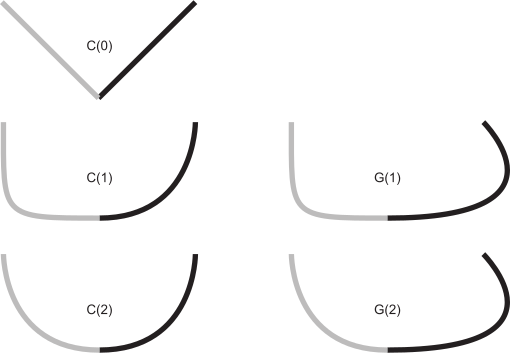
Figure 1:
An illustration of various types of continuity between two curve segmentsAn illustration of some continuity conditions is shown in Figure Figure 1. A discontinuity in the first derivative (the curve is but not ) is usually noticeable because it leads to a sharp corner. A discontinuity in the second derivative is sometimes visually noticeable. Discontinuities in higher derivatives might matter, depending on the application. For example, if the curve is a motion, an abrupt change in the 2nd derivative is noticeable, so 3rd derivative continuity is often useful. If the curve is going to have a fluid flowing over it (for example if it is the shape for an airplane wing or boat hull), a discontinuity in the 4th or 5th derivative might cause turbulence.
Because the “speed” of the parameterization might be different, even if the derivatives match, we define a different type of continuity that ignores the speed. We define geometric continuity to be the condition where the derivative of the end of one segment differs only in magnitude from the beginning of the next. That is, where the condition requires: