
Putting Pieces Together
Now that we’ve seen how to make individual pieces of polynomial curves, we can consider how to put these curve pieces together.
Knots
The basic idea of a piecewise parametric function is that each piece is only used over some parameter range. For example, if we want to define a function that has two piecewise linear segments that connect three points (as shown in Figure Figure (See below)), we might define:
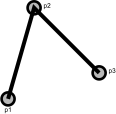
Figure 1:
Line segments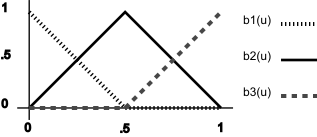
Figure 2:
Blending functionsTwo line segments connect three points. The blending functions for each of the points are graphed at right.
For each polynomial in our piecewise function, there is a site (or parameter value) where it starts and ends. Sites where a piece function begins or ends are known as knots. For the example of Equation Equation 1, the values of the knots are and
We may also write piecewise polynomial functions as the sum of basis functions, each scaled by a coefficient. For example, we can re-write the two line segments of Equation Equation 1 as
The knots of a polynomial function are the combination of the knots of all of the pieces that are used to create it. The knot vector is a vector that stores all of the knot values in sorted order.
Notice that in this section we have used two different mechanisms for combining polynomial pieces: using independent polynomial pieces for different ranges of the parameter and blending together piecewise polynomial functions.
Using Independent Pieces
In Section Polynomial Pieces, we defined pieces of polynomials over the unit parameter range. If we want to assemble these pieces, we need to convert from the parameter of the overall function to the necessary value of the parameter. The simplest way to do this is to define the overall curve over the parameter range where is the number of segments. Depending on the the value of the parameter, we can shift it to the required range.
Putting Segments Together
If we want to make a single curve from two line segments, we need to make sure that the end of the first line segment is at the same location as the beginning of the next. There are three ways to connect the two segments (in order of simplicity):
- Represent the line segment as its two endpoints, and then use the same point for both. We call this a shared-point scheme.
- Copy the value of the end of the first segment to the beginning of the second every time that the parameters of the first segment change. We call this a dependency scheme.
- Write an explicit equation for the connection, and enforce it through numerical methods as the other parameters are changed.
While the simpler schemes are preferable since they require less work, they also place more restrictions on the way the line segments are parameterized. For example, if we wanted to provide the center of the line segment as a parameter (so that the user could specify it directly), we might want to use the beginning of each line segment and the center of the line segment as their parameters. This would force us to use the dependency scheme.
Notice that if we use a shared point or dependency scheme, the total number of control points is less than where is the number of segments and is the number of control points for each segment; many of the control points of the independent pieces will be computed as functions of other pieces. Notice that if we use either the shared-point scheme for lines (each segment has its two endpoints as its parameters and shares interior points with its neighbors), or if we use the dependency scheme (such as the example one with the first endpoint and midpoint), we end up with controls for an segment curve.
Dependency schemes have a more serious problem. A change in one place in the curve can propagate through the entire curve. This is called a lack of locality. Locality means that if you move a point on a curve it will only effect a local region. The local region might be big, but it will be finite. If a curve’s controls do not have locality, changing a control point may effect points infinitely far away.
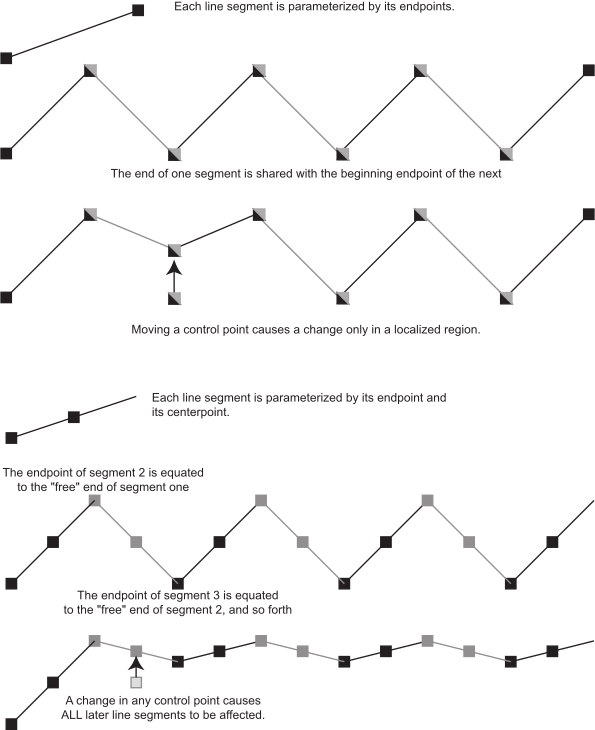
Figure 3:
A chain of line segments with local control and one with non-local controlTo see locality, and the lack thereof, in action, consider two chains of line segments, as shown in Figure Figure 3. One chain has its pieces parameterized by their endpoints and uses point-sharing to maintain continuity. The other has its pieces parameterized by an endpoint and midpoint, and uses dependency propagation to keep the segments together. The two segment chains can represent the same curves: they are both a set of connected line segments. However, because of locality issues, the endpoint-shared is likely to be more convenient for the user. Consider changing the position of the first control point in each chain. For the endpoint-sharing version, only the first segment will change, while all of the segments will be affected in the midpoint version, as in Figure Figure 3. In fact, for any point moved in the endpoint-shared version, at most two line segments will change. In the midpoint version all segments after the control point that is moved will change, even if the chain were infinitely long.
In this example, the dependency propagation scheme was the one that did not have local control. This is not always true. There are direct sharing schemes that are not local, and propagation schemes that are.
We emphasize that locality is a convenience of control issue. While it is inconvenient to have the entire curve change every time, the same changes can be made to the curve. It simply requires moving several points in unison.