
Cubics
In graphics, when we represent curves using piecewise polynomials we usually use either line segments or cubic polynomials for the pieces. There are a number of reasons why cubics are popular in computer graphics:
- Piecewise cubic polynomials allow for continuity, which is generally sufficient for most visual tasks. The smoothness that quadratics offer is often insufficient. The greater smoothness offered by higher order polynomials is rarely important.
- Cubic curves provide the minimum-curvature interpolants to a set of points. That is, if you have a set of points and define the “smoothest” curve that passes through them (that is the curve that has the minimum curvature over its length), this curve can be represented as a piecewise cubic with segments.
- Cubic polynomials have a nice symmetry where position and derivative can be specified at the beginning and end.
- Cubic polynomials have a nice tradeoff between the numerical issues in computation and the smoothness.
- The linear equations that cubics lead to (when using the matrix forms of Section Matrix Form for Polynomials) are , and computer graphicists tend to like matrices.
- Everyone in computer graphics seems to use cubics. It is what the books talk about, its what the graphics libraries best support, \ldots The popularity of cubics is somewhat self-perpetuating.
Notice that we do not have to use cubics. They just tend to be the best tradeoff between amount of smoothness and complexity. Different applications may have different tradeoffs. For example, many font rendering systems use quadratic polynomials. We focus on cubics since they are what most computer graphics end up use.
The canonical form of a cubic polynomial is:
In this chapter, we seek to find forms of cubic polynomials for which the coefficients are a convenient way to control the resulting curve represented by the cubic. One of the main conveniences will be to provide ways to insure the connectedness of the pieces and the continuity between the segments.
Each cubic polynomial piece requires 4 coefficients or control points. That means for a piecewise polynomial with pieces, we may require up to control points if no sharing between segments is done or dependencies used. More often, some part of each segment is either shared or depends on an adjacent segment, so the total number of control points is much lower. Also, note that a control point might be a position, or a derivative of the curve.
Unfortunately, there is no single “best” representation for a piecewise cubic. It is not possible to have a piecewise polynomial curve representation that has all of the following desirable properties:
- each piece of the curve is a cubic;
- the curve interpolates the control points;
- the curve has local control;
- the curve has continuity.
We can have any three of these properties, but not all four. The are representations that have any combination of three. In this document, we will discuss cubic B-Splines that do not interpolate their control points (but have local control and are ), Cardinal and Catmull-Rom splines that interpolate their control points and offer local control but are not , and natural cubics that interpolate and are but do not have local control.
The continuity properties of cubics refer to the continuity between the segments (at the knot points). The cubic pieces themselves have infinite continuity in their derivatives (the way we have been talking about continuity so far). Note that if you have a lot of control points (or knots), the curve can be wiggly, which might not seem “smooth.”
Natural Cubics
With a piecewise cubic curve, it is possible to create a curve. To do this, we need to specify the position, first and second derivative at the beginning of each segment (so that we can make sure that it is the same as the end of the previous segment). Notice, that each curve segment receives 3 out of its 4 parameters from the previous curve in the chain. These continuous chains of cubics are sometimes referred to as natural cubic splines.
For one segment of the natural cubic, we need to parameterize the cubic by the positions of its endpoints, and the first and second derivative at the beginning point. The control points are therefore:
Given a set of control points, a natural cubic splines has cubic segments. The first segment uses the control points to define its beginning position, ending position, and first and second derivative at the beginning. A dependency scheme copies the position, first, and second derivative of the end of the first segment for use in the second segment.
The disadvantage of natural cubic splines is that they are not local. Any change in any segment may require the entire curve to change (at least the part after the change was made). Another issue is that we only have control over the derivatives at the curve at its beginning. Segments after the beginning of the curve determine their derivatives from their beginning point.
Hermite Cubics
Hermite cubic polynomials were discussed in Section Basis Matrices for Cubics. A segment of a cubic Hermite Spline allows the positions and first derivatives of both of its end points to be specified. A chain of segments can be linked into a spline by using the same values for the position and derivative of the end of one segment and the beginning of the next.
Given a set of control points, where every other control point is a derivative value, a cubic Hermite spline contains cubic segments. The spline interpolates the points, as shown in Figure Figure (See below), but only can guarantee continuity.
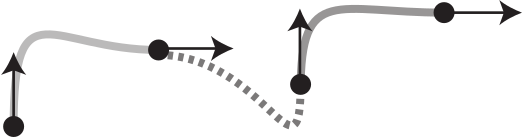
Figure 1:
A Hermite Cubic Spline made of 3 segments.Hermite cubics are convenient because they provide local control over the shape, and provide continuity. However, since the user must specify both positions and derivatives, a special interface for the derivatives must be provided. One possibility is to provide the user with points that represent where the derivative vectors would end if they were “placed” at the position point.
Cardinal Cubics
A Cardinal Cubic Spline is a type of interpolating spline made up of cubic polynomial segments. Given a set of control points, a cardinal cubic spline uses cubic polynomial segments to interpolate all of its points except for the first and last.
Cardinal Splines have a parameter called tension that controls how “tight” the curve is between the points it interpolates. For the important special case of the splines are called Catmull-Rom splines.
Each segment of the cardinal spline uses 4 control points. For segment the points used are , , , and as the segments share 3 points with their neighbors. Each segment begins at its second control point and ends at its third control point. The derivative at the beginning of the curve is determined by the vector between the first and third control points, while the derivative at the end of the curve is given by the vector between the second and forth points, as shown in Figure Figure (See below).
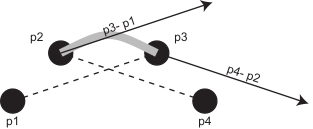
Figure 2:
A segment of a cardinal cubic spline interpolates its second and third control points (\mathbf{p_2} and \mathbf{p_3}), and uses its other points to determine the derivatives at the beginning and end.The tension parameter adjusts how much the derivatives are scaled. Specifically, the derivatives are scaled by The constraints on the cubic are therefore:
This gives the cardinal matrix
Since the third point of segment is the second point of segment , adjacent segments of the cardinal spline connect. Similarly, the same points are used to specify the first derivative of each segment, providing continuity.
Cardinal splines are useful because they provide an easy way to interpolate a set of points with continuity and local control. They are only , so they sometimes get “kinks” in them. The tension parameter give some control over what happens between the interpolated points, as shown in Figure Figure (See below).
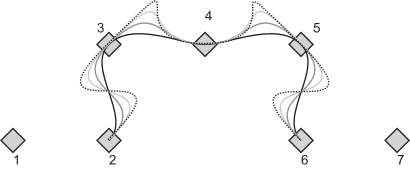
Figure 3:
Cardinal splines through the 7 control points with varying values of tension parameter t.In Figure Figure 3, a set of cardinal splines through a set of points are shown. The curves use the same control points, but use different values for the tension parameters. Note that the first and last control points are not interpolated.
Given a set of points to interpolate, you might wonder why we might prefer to use a cardinal cubic spline (that is a set of cubic pieces) rather than a single, order polynomial as described in Section Interpolating Polynomials. Some of the disadvantages of the interpolating polynomial are:
- The interpolating polynomial tends to overshoot the points, as seen in Figure Figure (See below). This overshooting gets worse as the number of points grows greater. The cardinal splines tend to be well behaved in between the points.
- Control of the interpolating polynomial is not local. Changing a point at the beginning of the spline affects the entire spline. Cardinal splines are local: any place on the spline is affected by its 4 neighboring points at most.
- Evaluation of the interpolating polynomial is not local. Evaluating a point on the polynomial requires access to all of its points. Evaluating a point on the piecewise cubic requires a fixed small number of computations, no matter how large the total number of points is.
There are a variety of other numerical and technical issues in using interpolating splines as the number of grows larger. See (Source: deboor-splines-book) for more information.
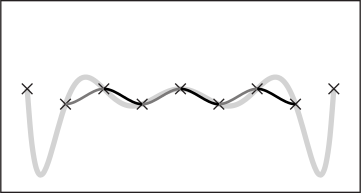
Figure 4:
Splines interpolating 9 control points (marked with small crosses). The thick gray line shows an interpolating polynomial. The thin, dark line shows a Catmull-Rom spline. The latter is made of 7 cubic segments, which are each shown in alternating gray tones.A cardinal spline has the disadvantage that it does not interpolate the first or last point, which can be easily fixed by adding an extra point at either end of the sequence. The cardinal spline also is not as continuous - providing only continuity at the knots.