
Bezier Curves
Bezier curves are one of the most common representations for free-form curves in computer graphics. The curves are named for Pierre Bezier, one of the people who were instrumental in their development. Bezier curves have an interesting history where they were concurrently developed by several independent groups.
Warning: the original notes were written using a mix of “degree” and “order” for the notation (d and n). This was confusing. The book more consistently uses order, while I think degree is clearer. I have tried to use d more consistently, but there are places where order sneaks in.
A Bezier curve is a polynomial curve that approximates its control points. The curves can be any degree of polynomial. A curve of degree is controlled by control points. The curve interpolates its first and last control points, and the shape is directly influenced by the other points.
Often, complex shapes are made by connecting a number of Bezier curves of low degree. To avoid confusion, we refer to each polynomial piece as a segment. In computer graphics, cubic () Bezier curves are the most commonly used for each segment. Many popular illustration programs, such as Adobe Illustrator, and font representation schemes, such as that used in Postscript, use cubic Bezier segments. Bezier curves are extremely popular in computer graphics because they are easy to control, have a number of useful properties, and there are very efficient algorithms for working with them.
Bezier curves are constructed such that:
- the curve interpolates the first and last control points, with and respectively;
- the first derivative of the curve at its begining (end) is determined by the vector between the first and second (next to last and last) control points. The derivatives are given by the vectors between these points scaled by the degree of the curve;
- higher derivatives at the begining (end) of the curve depend on the points at the begining (end) of the curve. The derivative depends on the first (last) points.
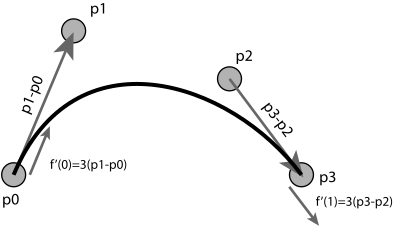
Figure 1:
A cubic Bezier segment is controlled by four points. It interpolates the first and last, and the begining and final derivatives are 1/3 of the vectors between the first two (or last two) points.For example, consider the Bezier curve of degree 3 as in Figure Figure 1. The curve has four () control points. It begins at the first control point () and ends at the last (). The first derivative at the begining is proportional to the vector between the first and second control points (). Specifically, . Similarly, the first derivative at the end of the curve is given by . The second derivative at the begining of the curve can be determined from control points , and .
Using the facts about Bezier cubics in the preceeding paragraph, we can use the methods of Section Cubics to create a parametric function for them. The definitions of the begining and end interpolation and derivatives give:
Fortunately, the blending functions for Bezier curves have a special form that works for all degrees. These functions are known as the Bernstein Basis Polynomials and have the general form
Given the positions of the control points the function to evaluate the Bezier curve of degree (with control points) is:
Some Bezier segments are shown in Figure Figure (See below).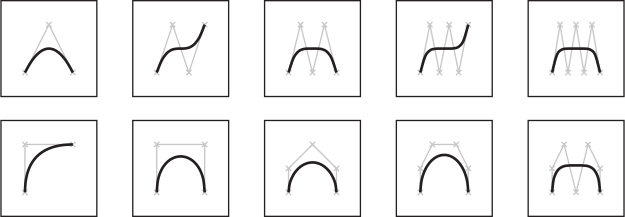
Figure 2:
Various Bezier segments of degree 2-6. The control points are shown with crosses, and the control polygon (line segments connecting the control points) are also shown.
Bezier segments have several useful properties:
- The curve is bounded by the convex hull of the control points.
- Any line intersects the curve no more times than it intersects the set of line segments connecting the control points. This is called the variation diminishing property. This property is illustrated in Figure Figure (See below).
- The curves are symmetric: reversing the order of the control points yields the same curve, with a reversed parameterization.
- The curves are affine invariant. This means that translating, scaling, rotating, or skewing the control points is the same as performing those operations on the curve itself.
- There are good simple algorithms for evaluating and subdiving Bezier curves into pieces that are themselves Bezier curves. A good subdivision algorithm makes divide and conquer algorithms viable.
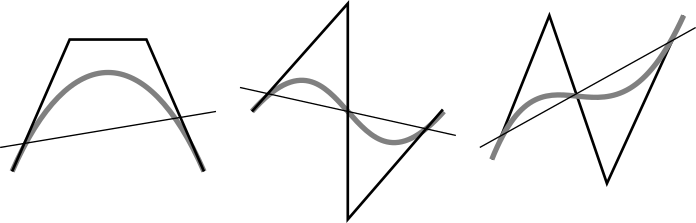
Figure 3:
The variation diminishing property of Bezier Curves means that the curve crosses does not cross a line more than its control polygon does. Therefore, if the control polygon has no wiggles the curve will not either. B-Splines (Section B-Splines) also have this property.When Bezier segments are connected together to make a spline, connectivity between the segments is created by sharing the endpoints. However, continuity of the derivatives must be created by positioning the other control points. This provides the user of a Bezier spline with control over the smoothness. For continuity, the 2nd to last point of the first curve and the second point of the 2nd curve must be collinear with the equated endpoints. For continuity, the distances between the points must be equal as well. This is illustrated in Figure Figure (See below).
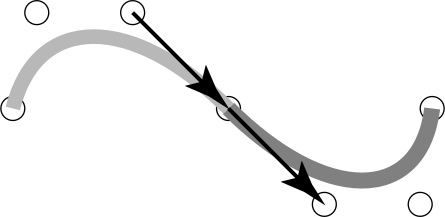
Figure 4:
Two Bezier segments connect to form a C(1) spline because the vector between the last two points of the first segment is equal to the vector between the first two points of the second segment.Geometric Intuition for Bezier Curves
Bezier curves can be derived from geometric principles, as well as the algebraic methods described above. We outline this because it provides intuitions for how Bezier curves work.
Imagine that we have a set of control points that we want to create a smooth curve from. Simply connecting the points with lines (to form the control polygon) will lead to something that is non-smooth. It will have sharp corners. We could imagine “smoothing” this polygon by cutting off the sharp corners, yielding a new polygon that was smoother, but still not “smooth” in the mathematical sense (since the curve is still a polygon, and therefore only We could repeat this process, each time yielding a smoother polygon, as shown in Figure Figure (See below). In the limit, that is if we repeated the process infinitely many times, we would obtain a smooth curve.
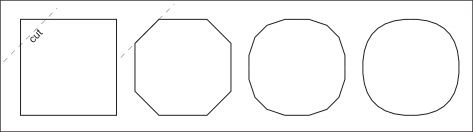
Figure 5:
By repeatedly cutting the corners off a polygon, we approach a smooth curve.What we have done with corner cutting is defining a subdivision scheme. That is, we have define curves by a process for breaking a simpler curve into smaller pieces (e.g. subdividing it). The resulting curve is the limit curve that is achieved by applying the process infinitely many times. If the subdivision scheme is define correctly, the result will be a smooth curve and will have a parametric form.
Let us consider applying corner cutting to a single corner. Given three points ( ), we repeatedly “cut off the corners” as shown in Figure Figure (See below). At each step, we divide each line segment in half, connecting the midpoints, and then move the corner point to the midpoint of the new line segment. Note that in this process, new points are introduced, moved once, and then remain in this position for any remaining iterations. The endpoints never move.
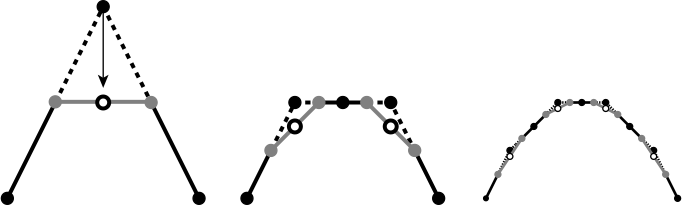
Figure 6:
Subdivision procedure for Quadratic Beziers. Each line segment is divided in half and these midpoints are connected (gray points and lines). The interior control point is moved to the midpoint of the new line segment (white circle).If we compute the “new” position for as the midpoint of the midpoints, we get the expression:
The De Casteljeau Algorithm
One nice feature of Bezier Curves is that there is a very simple and general method for computing and subdiving them. The method, called the de Casteljau Algorithm, uses a sequence of linear interpolations to compute the positions along the Bezier curve of arbitrary order. It is the generalization of the subdivision scheme described in the previous section.
The De Casteljau algorithm begins by connecting every adjacent set of points with lines, and finding the point on these lines that is the interpolation, providing a set of points. These points are then connected with straight lines, those lines are interpolated (again by ), giving a set of points. This process is repeated until there is one point. An illustration of this process is shown in Figure Figure (See below).
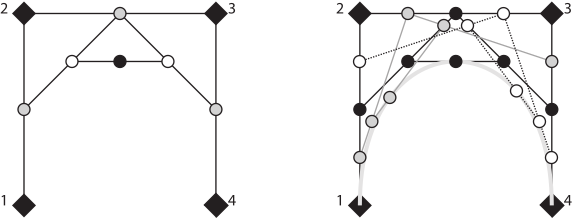
Figure 7:
An illustration of the De Casteljau algorithm for a cubic Bezier. The left shows the construction for u=.5. The right shows the construction for .25, .5, and .75.The process of computing a point on a Bezier segment also provides a method for dividing the segment at the point. The intermediate points computed during the de Casteljau algorithm form the new control points of the new, smaller segments, as shown in Figure Figure (See below).
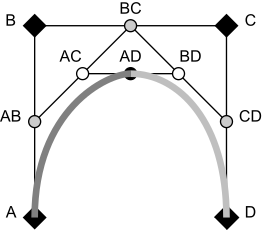
Figure 8:
The de Casteljau algorithm is used to subdiving a cubic Bezier segment. The initial points (black diamonds A, B, C, and D) are linearly interpolated to yield gray circles (AB, BC, CD), which are linearly interpolated to yield white circles (AC, BD), which are linearly interpolated to give the point on the cubic AD. This process also has subdivided the Bezier segment with control points A,B,C,D into two Bezier segments with control points A, AB, AC, AD and AD, BD, CD, D.The existence of a good algorithm for dividing Bezier curves makes possible divide-and-conquer algorithms. For example, when drawing a Bezier curve segment, it is easy to check to see if the curve is close to being a straight line because it is bounded by its convex hull. If the control points of the curve are all close to being co-linear, the curve can be drawn as a straight line. Otherwise, the curve can be divided into smaller pieces, and the process can be repeated. Similar algorithms can be used for tasks like determining the intersection between two curves. Because of the existence of such algorithms, other curve representations are often converted to Bezier form for processing.